Introduction
Private credit, more precisely large non-listed BDCs, are in the headlines. These structures provide access to private credit, previously limited to institutions and HNW individuals, and tout yields of 10% or more in a liquid interval fund format.
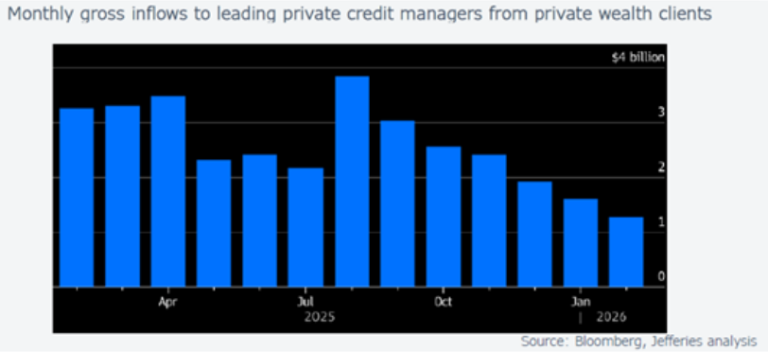
After nearly a decade of delivering as promised, a series of subprime defaults and concerns about AI disruption of SaaS business models have raised questions about portfolio quality among investors, leading to redemptions requests well in excess of fund gates.
While the asset managers argue the defaults are idiosyncratic events, there is a growing concern they are the canary in the coalmine of broader systemic risks
We are not going to debate these points. The opacity of reporting makes it difficult to definitively challenge their claims, while others have taken deep dives into the various funds.
And it’s not clear it matters. The recent redemption pressure reflects deeper fundamental issues, and we don’t expect any amount of logical argument or cajoling by the funds will be able to stem them. Effectively the managers have sold a product that requires continuous flows to stabilize their assets. At its surface they offered short term liquidity to an asset class that requires long term ownership; in process they broke the first rule of finance, matching assets and liabilities.
The problem is not the seniority of the loans, their fundamentals, or sources of liquidity. The problem is the incentive created by the opacity and structure of the to redeem even if you believe the manager (though it’s not clear whether investors actually do any longer).
The question is not: Is this time different? Though we don’t believe it is.
The question now is: How bad might it be? We don’t know but suspect current with (at a minimum) contagion to other private interval structures.
Where Were We?
Market concerns about the underlying portfolios of the non-listed BDCs have been growing for some time. In our April 2025 Insights Note “Why Own Fixed Income? Our Purpose-Driven Approach” we expressed our view:
We’re Avoiding “the golden age of Private Credit”. While we will not name names, a review of the public filings from most publicly traded BDCs reveals that a vast majority of their portfolio holdings are marked at or near par, or at recovery values. These filings often present binary outcomes – i.e., assets are either performing perfectly or classified as “disasters”. This raises the question of how we evaluate the situations that fall in between where investments are either underperforming or haven’t blown up.
For example, in one portfolio of the 369 bonds of size, 276 (75%) were marked at or above par, 60 (16%) were marked within 5% of par, and 17 (5%) were marked at what appears to be recovery values. These results indicate that of the 369 bonds, only 4% were marked somewhere between “perfect” and “default”. While this is not a scientific exercise, common sense suggests that in this type of vehicle, it is quite likely to see investments shift rapidly from perfect to defaulted with little prior warning.
We revisited these concerns in November 2025 as the Tricolor and First Brands defaults raised credit risk concerns. The chart below shows that listed private credit BDCs (CWBDC Index[1]) traded down to a discount relative to their NAV (CWBDC NAV) and presumably to the NAV of non-listed BDCs managed by the same groups and allocated to the same / similar loans.
The discount suggests either the market believes there are credit risks not fully reflected in the fund NAVs or that the market is highly inefficient and overreacting to the high-profile defaults. We’ll put our money on the market.
[1] The Cliffwater BDC Index (CWBDC Index) seeks to track the total return of exchange-traded BDCs.

Where Are We?
A concern is that the large capital inflows into private credit BDCs have resulted in weaker underwriting standards and a tendency to extend and pretend rather than recognize losses on loans. The use of Payment-in-Kind, with interest accrued instead of paid, and Liability Management Exercises (LME) has increased, suggesting portfolio companies cannot service debt from cash flows. In a recent market outlook, Sculptor Capital notes:
“The weakening of anti-layering protections, combined with limited access to traditional markets, has led many businesses facing stress and imminent debt maturities to adopt widely accepted liability management transactions instead of filing for bankruptcy.”
The democratization of private credit, selling to the wealth channels as a liquid investment, re-introduced the asset-liability mismatch the interval fund structure was designed to solve. All financial innovation is either a way to increase distribution or increase leverage. The argument that a broadly diversified pool of senior secured loans to subprime borrowers translates into a low default rate bears an uncomfortable resemblance to the argument that a geographically diversified portfolio of residential subprime mortgages reduces default risk to the point that a AAA-rating is warranted.
Where Are We Going?
We expect non-listed BDC redemption requests to continue. Investors face a prisoner’s dilemma where the equilibrium is to redeem. Wealth Advisors may not know what other wealth advisors are doing, but they have all heard John Zito, Co-President of Apollo Asset Management, state “I literally think all the marks are wrong” and they all know there is no FDIC standing ready to make their clients whole.
No amount of reassurances or claims that the fundamentals are sound will overcome the career risk of being wrong and alone as the last investor holding the bag of low-quality loans that can’t be sold. Investors should expect worst-case liquidity, a full redemption will take 5 years, as “the time you want to exit will be the same time as everyone else wants to exit”
We expect funds to enforce the 5% redemption gates. Funds face a prisoner’s dilemma where the equilibrium is to gate.
Firms are preparing investors for this eventuality, with gating being positioned as foundational to the structure and good for investors. While some firms such as Blackstone offered redemptions above the 5% gate, the BlackRock decision to maintain the 5% gate means there is now no incentive for other firms to relax their gates. As we saw during the GFC, those funds that don’t or are unable to gate risk becoming ATMs and closure.
However, this may not prevent losses as portfolios are forced to mark down loans.
While a logical possibility, it’s not clear the funds anticipated, or believed that gates would solve, the issue of everyone wanting to liquidate at once. The problem becomes acute when loans mature and there is no or insufficient capital to refinance problem loans, at which point losses will quickly eat into equity.
While the funds can meet the 5% redemptions for now, they will force a reckoning in portfolio companies that assumed their notes would be extended.
AI is not the problem. While the SaaSpocalype has captured headlines, the defaults to date have not been AI but consumer-facing loans, in particular consumers in the lower leg of the K-shaped recovery, notably:
- Tricolor, a used car retailer and subprime lender.
- First Brands, an auto parts retailer.
- Perch, an e-commerce aggregator.
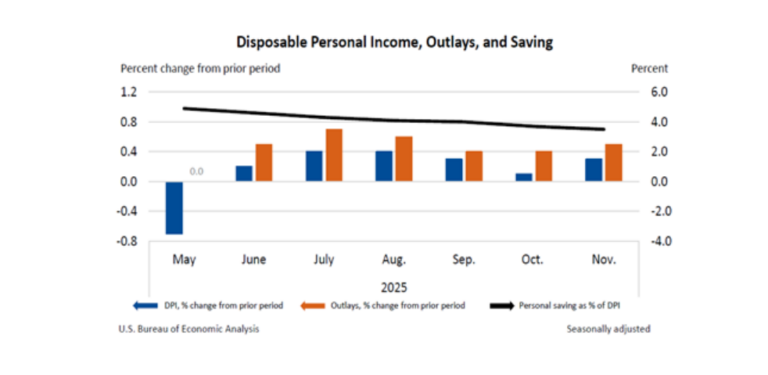
This may remain the case as affordability remains an issue. Personal savings are trending lower as personal consumption expenditures (PCE) continue to outpace disposable personal income (DPI).
The next shoe to drop may be Buy now, Pay later (BNPL), a strategy that unwinds quickly if the end borrower is unable to repay or refinance. The canary is Klarna (KLAR), which went public in September 2025 at $40 / share. While Q3 reporting in November reported a revenue beat, there was a sharp increase in provisions for credit losses with the share price falling ~27% following Q4 2025 results of a -$0.12 loss against expectations of -$0.03. A lawsuit was filed in December alleging the rise in provisions for credit losses was reasonably foreseeable at the time of the IPO, but Klarna failed to disclose it.
Gating creates the potential for contagion as investors seek other sources of liquidity. In particular, other private asset interval fund structures (e.g., real estate) managed by the same firms would seem a likely source to reduce risk to the gating and the asset management firms.
There are also likely to be ripples with lower inflows to other strategies with investors backing away from commitments due to a lack of expected inflows.
There is also the potential contagion through insurance company balance sheets. We estimate that upwards of 29% of private credit is held by insurers, many of which are affiliates of the asset managers. Insurance companies often leverage structures like Rated Note Feeders and Collateralized Fund Obligations to invest in private credit. These structures receive a rating—increasingly from smaller agencies, according to Fitch—that allow the insurers to invest in private credit without strict capital constraints. The NAIC has adopted a proposal to contest these ratings, which took effect in January. Contested ratings and the possibility of stricter capital requirements would likely drive further redemption requests from a large cohort of the private credit market.
Conclusion
The point here is not that we do not like private credit. Rather we believe that structure, incentives and the starting point matter, this is inherently our concern with some of the private credit structures. We deploy capital only where the expected reward justifies the risk exposure. We believe such opportunities currently exist in more focused, capital-constrained credit markets. There is also the potential that, similar to the GFC, there will be opportunities in private credit as valuations are marked down as the current imbalance is resolved.
We are leery of non-listed BDCs given the incentives created by the structure and distribution into the wealth channels. We believe those incentives will drive continued redemptions, continued gating and unfortunate losses for current investors.
Memorandum Disclosures
This Memorandum is confidential and may contain legally privileged and proprietary information of Twin Focus Capital Partners LLC (“TwinFocus”). It is intended solely for the use of the Recipients to which it is addressed. If you are not the intended recipient, you are hereby notified that any dissemination, copy, disclosure, use or action taken based on this Memorandum or any information herein is strictly prohibited and may be unlawful. If you received this Memorandum in error, please contact the sender immediately and destroy the material in its entirety, whether electronic or hard copy.
This Memorandum may not be otherwise redistributed, retransmitted or disclosed, in whole or in part, or in any form or manner, without the express written consent of Twin Focus Capital Partners LLC.
Investments involve numerous risks, including, among others, market risk, counterparty default risk and liquidity risk. In some cases, securities, strategies and other financial instruments may be difficult to value or sell and reliable information about the value or risks related to the security, strategy or financial instrument may be difficult to obtain. Income from such securities, strategies and other financial instruments, if any, may fluctuate and that price or value of such securities, strategies and instruments may rise or fall and, in some cases, investors may lose their entire principal investment. Foreign currency rates of exchange may adversely affect the value, price or income of any security or financial instrument mentioned in this Memorandum. Investors in such securities and instruments effectively assume currency risk. Additionally, before investing in any mutual fund strategies, Recipients are advised to obtain and closely review prospectuses and related information for those strategies before making any final investment decision.
Hedge fund and other alternative investments are generally unregulated and considered inherently very risky and you can lose material portions of your principal in very short periods of time. Prior to making any investments in any hedge fund managers and alternative investment strategies, you should thoroughly review all subscription documents and confidential offering memoranda provided by the managers/strategies, paying particular attention to the risk disclosures. You should not invest in such managers/strategies if you are not thoroughly comfortable with these risk disclosures or do not understand and/or appreciate the increased levels of risks associated with such strategies. Additionally, this Memorandum may provide information regarding private funds/strategies/investments which are exempt from registration under the Investment Company Act of 1940 pursuant to Section 3(c)(1) and/or 3(c)(7) which were offered as private placements in reliance on Regulation D of the Securities Act of 1933. Each individual fund/strategy and NOT TwinFocus shall have the sole responsibility for (i) formally qualifying prospective investors to ensure they meet the suitability criteria to invest in each relevant fund/strategy and, once qualified, (ii) sending the formal offering documents and other materials to each prospective investor.
Any information relating to the tax status of financial instruments and/or strategies discussed herein is not intended to provide tax advice or to be used by anyone to provide tax advice. Recipients are urged to seek tax advice based on their particular circumstances from an independent tax professional. Any waiver by TwinFocus of any section of this Memorandum Disclaimer Statement should not be construed as a general waiver of any other section and/or the entire Memorandum Disclaimer Statement.
The information, including but not limited to forecasts and estimates, in this Memorandum was obtained from various sources and TwinFocus does not guarantee its accuracy. Although the information contained in this Memorandum are from sources believed to be reliable, no representation or warranty, expressed or otherwise, is made to, and no reliance should be placed on its fairness, accuracy, completeness or timeliness.
All opinions, projections and estimates are as of the date of the Memorandum and are subject to change without notice. TwinFocus is under no obligation to update this Memorandum and Recipients should therefore assume that TwinFocus will not update any fact, circumstance or opinion contained in this Memorandum unless specifically requested. TwinFocus and any director, officer or employee of TwinFocus do not accept any liability whatsoever for any direct, indirect or consequential damages or losses arising from any use of this Memorandum or its contents.
This Memorandum may contain current opinions of third-party authors and not necessarily those of TwinFocus. Such opinions are subject to change without notice.
This Memorandum may contain references to market indices. Such information is presented to show the general trends in certain markets for the periods indicated and is not intended to imply that the strategy(s) discussed and/or reviewed are similar to the indices either in composition or element of risk. TwinFocus does not make any representations as to whether the indices may or may not be unmanaged, not investable, have any expenses and may or may not reflect reinvestment of dividends and distributions. Index data is provided for comparative purposes only. A variety of factors may cause an index to be an inaccurate benchmark for a particular portfolio/manager/strategy and the index does not necessarily reflect the actual investment strategy of the portfolio/manager/strategy discussed and/or presented in the Memorandum. Current period returns may be estimates. Actual index returns and/or estimates are calculated and presented to TwinFocus through third party software providers and as such, may differ from the final figures produced by the index provider.