
Introduction
In April 2025, we published Why Own Fixed Income? Our Purpose-Driven Approach, arguing that fixed income is not a portfolio ballast or filler, but rather “a suite of precise and targeted tools”. In practice, that meant favoring short duration, senior CLO tranches, closed-end municipal funds trading at wide NAV discounts, and niche private credit with outsized return potential, while avoiding public corporate bonds at tight spreads and mainstream private credit.
The fixed income landscape has since shifted
The Fed raised rates for the first time in over 3 years in September with the dot plot indicating another increase by the December FOMC meeting. Treasury markets responded sharply, with 2-year yields reaching their highest levels since 2024. Hyperscaler issuance combined with persistent and growing deficits as we transition to a multipolar world, has pushed longer maturity Treasury yields to levels not seen in nearly 2 decades, with the 30-year reaching its highest level since 2007. The Treasury responded by announcing at least a doubling of its liquidity-support buyback operations in the 10- to 30-year maturities. While yields fell initially, a further buyback announcement was met with outright selling, with the 30-year pushing back over 5.3%. With breakeven inflation rates well behaved, the increase largely reflects rising real rates and a widening term premium.
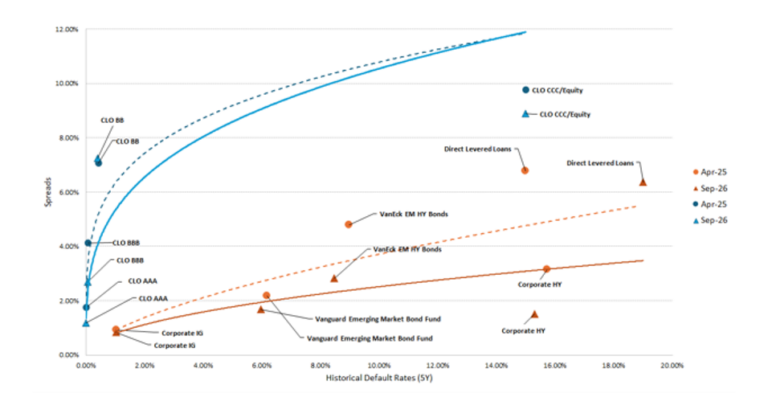
Conversely, spreads have compressed across the major fixed income sub-categories while default rates have largely been stable.
Sources: Various, TwinFocus
While yield levels are attractive in absolute terms, we noted that “when spreads are tight, returns are generally low”. The question we asked in April 2025 remains: where are investors being adequately compensated for assuming additional duration and default risk?
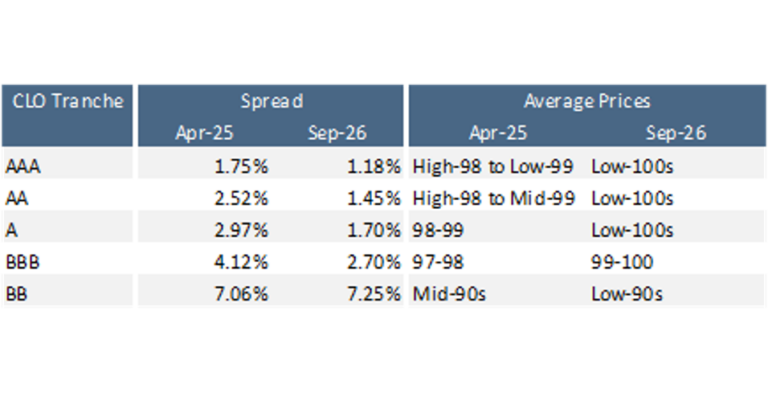
CLO spreads have generally tightened with the balance of upside-to-downside risk less attractive. In April of 2025, we concluded that AAA CLOs were interesting. Since then, AAA CLO spreads have tightened materially, compressing the floating-rate coupons on new issues and increasing spread risk. While AAA CLOs are not expected to be impaired outside of severe default scenarios, the balance of upside-to-downside risk became less attractive, and we rotated exposure into short-term money market securities.
Sources: CFIC, Nuveen
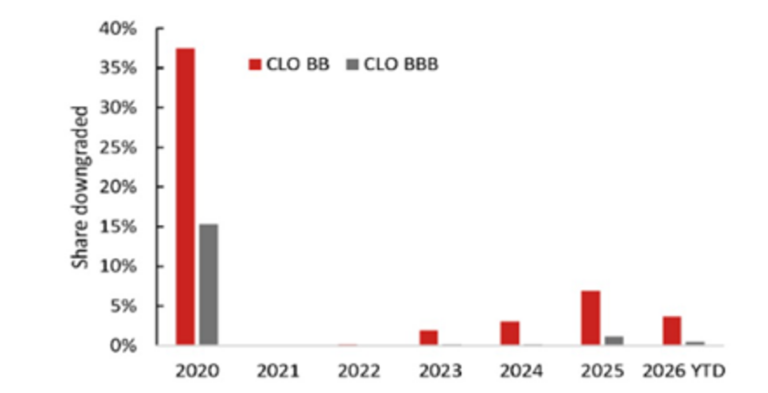
Spreads across CLO tranches are not linear, nearly doubling from A to BBB and more than doubling from BBB to BB, as the BB spread is little changed. The caveat is that the share of downgraded BB CLOs has risen, though slowing YTD, while BBB CLO downgrades have reemerged.
Source: CIFC, Intex, Bloomberg, Nomura
In parallel, Bloomberg reports that rating agencies are poised to upgrade CLO bonds as they revise their methodologies. Moody’s is reviewing 24% of outstanding US CLOs and 52% of European CLOs rated. Fitch expects positive changes, typically 1-2 notches, on an estimated 5-15% of CLO ratings.
The agencies argue the revisions reflect realized CLO performance. The scale and timing though have revived fears of ratings inflation similar to that preceding the Global Financial Crisis when competition among rating agencies gave managers room to ratings shop. Those concerns are heightened by building stress in software and services, which accounts for ~15% of US CLO collateral.
Time will tell if the rating revisions appropriately reflect future CLO performance or whether the agencies are anchoring on the past just as underlying credit risk is turning.
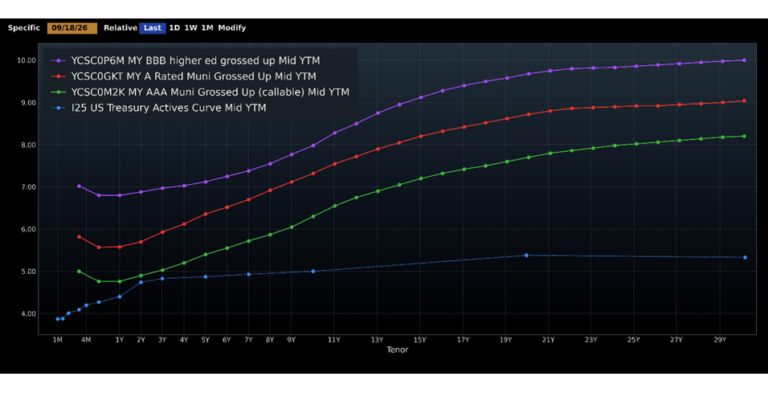
Municipal bond tax equivalent yields remain attractive. The municipal yield curve is steep, providing attractive tax equivalent yields (TEY) at longer durations, while municipal balance sheets are healthy, providing opportunities in the high yield and taxable markets. The curve is steepest through 20 years where AAA general obligation TEY are around 6.4% while the BAA GO TEY is around 8%.
Source: Bloomberg
We favor active management given the dispersion of credit risks across issues, sectors and structures.
The case for Emerging Market debt is more balanced as spreads have compressed and heightened geopolitical risks call for greater selectivity. Fiscal credibility has migrated given that emerging market credit ratings have broadly improved and developed market ratings have been lowered, as EM countries have improved their fiscal positions and benefit from stronger current account balances. Yields remain higher while EM central banks, which raised rates early and aggressively in 2021–22, are positioned to cut into positive real rates while developed markets face persistent inflation and widening deficits. EM local currency bonds also provide US dollar diversification.
While we have typically favored dollar-denominated exposure, we seek active strategies, given the broad dispersion of risk and return, with the flexibility to allocate to local currency to capture more attractive risk-adjusted yields as structural shifts raise the potential for longer-term US dollar weakness.
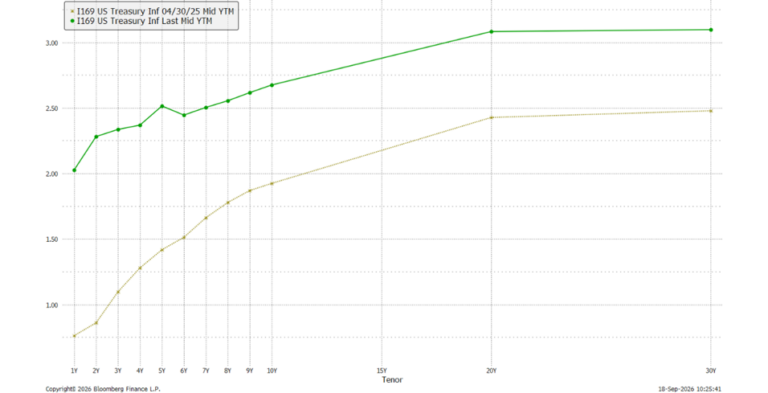
Treasury Inflation-Protected Securities (TIPS) have become interesting again. The real yield curve has shifted higher and flattened, lying largely above 2% with the 10-year ~2.6% and the long-end above 3%. TIPS principal is adjusted to track CPI-U while receiving the greater of the adjusted principal or face value at maturity, providing solid returns during periods of rising inflation, an otherwise challenging environment for fixed income. The broad TIPS market exposure encompasses interest rate risk with a duration over 7.5 years, with short duration TIPS mitigating this risk by generally holding bonds with maturities of 5 years or less.
Source: Bloomberg
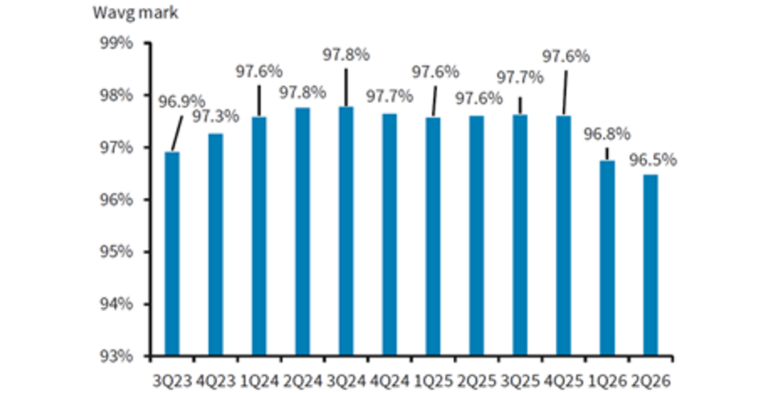
We remain wary of Private Credit beta… and continue to be selective within private credit as the bar to tie up capital in less liquid funds has risen with publicly traded BDCs marked at or near par, non-listed BDCs continuing to gate redemptions and with growing signs of strain.
Source: JF Lehman
PIMCO argues traditional default measures understate the true level of distress in direct lending. Their “shadow default” measure suggests 19% of issuers of first- and second-lien loans held by BDCs were in some form of distress as of March 2026, up from roughly 14% in 2022. Most of these events were “soft” defaults, e.g., maturity extensions, rather than outright payment failures while the level has stabilized over the last few quarters.
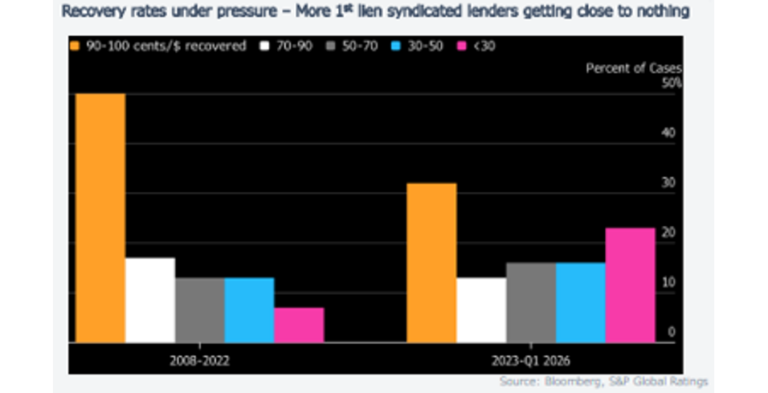
Over the last 3 years, first-lien syndicated loan recoveries have declined, with recoveries below 30% rising while recoveries of 90% or higher have declined, likely reflecting underlying structural changes such as declining junior debt, which traditionally absorbed losses before senior lenders, the increase in software and service business loans, reducing tangible collateral, and liability management exercises, which have weakened creditor protections.
Source: JF Lehman, Bloomberg
The point here is not that we do not like private credit. Rather we believe that structure, incentives and starting point matter. High-single to low-double-digit returns do not appear sufficient compensation for potential risk exposures. Instead, we believe opportunities where expected returns justify the risks currently exist in more focused, capital-constrained credit markets.
With regard to public corporate bonds, as we noted in April 2025:
Even today spreads haven’t moved anywhere near historical levels. You may hear “the quality is better now” but we view this as equivalent to saying “this time it is different.”
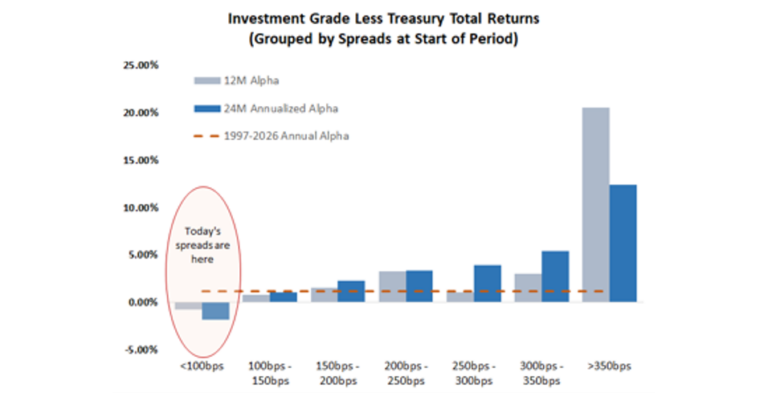
Since then, investment grade and high yield corporate bond spreads have tightened further and are in the range where 12- and 24-month returns have historically been lower than the return to Treasuries.
Source: Federal Reserve Bank of St. Louis, Bloomberg, TwinFocus
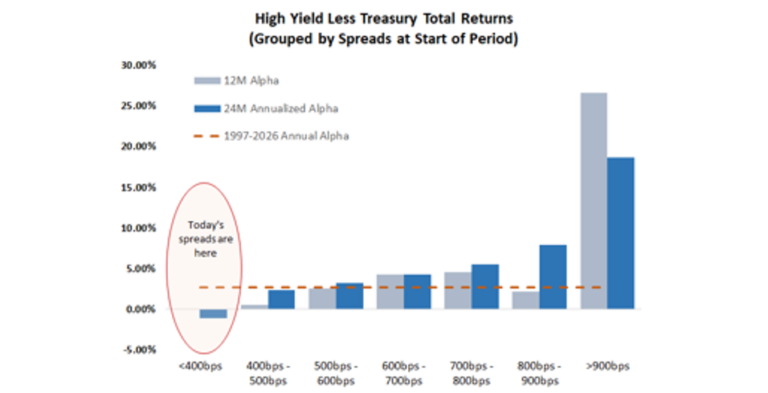
Source: Federal Reserve Bank of St. Louis, Bloomberg, TwinFocus
Conclusion
Bonds continue to have a place in client portfolios, but the right allocation remains dynamic with credit and duration treated as risks to be managed rather than static allocations. With Treasury yields elevated, spreads tight and signs of private credit stress, we remain selective, focused on markets that provide for more attractive risk-adjusted expected returns.
Memorandum Disclaimers & Disclosures
This Memorandum is confidential and may contain legally privileged and proprietary information of Twin Focus Capital Partners LLC (“TwinFocus”). It is intended solely for the use of the Recipients to which it is addressed. If you are not the intended recipient, you are hereby notified that any dissemination, copy, disclosure, use or action taken based on this Memorandum or any information herein is strictly prohibited and may be unlawful. If you received this Memorandum in error, please contact the sender immediately and destroy the material in its entirety, whether electronic or hard copy.
This Memorandum may not be otherwise redistributed, retransmitted or disclosed, in whole or in part, or in any form or manner, without the express written consent of Twin Focus Capital Partners LLC.
Investments involve numerous risks, including, among others, market risk, counterparty default risk and liquidity risk. In some cases, securities, strategies and other financial instruments may be difficult to value or sell and reliable information about the value or risks related to the security, strategy or financial instrument may be difficult to obtain. Income from such securities, strategies and other financial instruments, if any, may fluctuate and that price or value of such securities, strategies and instruments may rise or fall and, in some cases, investors may lose their entire principal investment. Foreign currency rates of exchange may adversely affect the value, price or income of any security or financial instrument mentioned in this Memorandum. Investors in such securities and instruments effectively assume currency risk. Additionally, before investing in any mutual fund strategies, Recipients are advised to obtain and closely review prospectuses and related information for those strategies before making any final investment decision.
Hedge fund and other alternative investments are generally unregulated and considered inherently very risky and you can lose material portions of your principal in very short periods of time. Prior to making any investments in any hedge fund managers and alternative investment strategies, you should thoroughly review all subscription documents and confidential offering memoranda provided by the managers/strategies, paying particular attention to the risk disclosures. You should not invest in such managers/strategies if you are not thoroughly comfortable with these risk disclosures or do not understand and/or appreciate the increased levels of risks associated with such strategies. Additionally, this Memorandum may provide information regarding private funds/strategies/investments which are exempt from registration under the Investment Company Act of 1940 pursuant to Section 3(c)(1) and/or 3(c)(7) which were offered as private placements in reliance on Regulation D of the Securities Act of 1933. Each individual fund/strategy and NOT TwinFocus shall have the sole responsibility for (i) formally qualifying prospective investors to ensure they meet the suitability criteria to invest in each relevant fund/strategy and, once qualified, (ii) sending the formal offering documents and other materials to each prospective investor.
Any information relating to the tax status of financial instruments and/or strategies discussed herein is not intended to provide tax advice or to be used by anyone to provide tax advice. Recipients are urged to seek tax advice based on their particular circumstances from an independent tax professional. Any waiver by TwinFocus of any section of this Memorandum Disclaimer Statement should not be construed as a general waiver of any other section and/or the entire Memorandum Disclaimer Statement.
The information, including but not limited to forecasts and estimates, in this Memorandum was obtained from various sources and TwinFocus does not guarantee its accuracy. Although the information contained in this Memorandum are from sources believed to be reliable, no representation or warranty, expressed or otherwise, is made to, and no reliance should be placed on its fairness, accuracy, completeness or timeliness.
All opinions, projections and estimates are as of the date of the Memorandum and are subject to change without notice. TwinFocus is under no obligation to update this Memorandum and Recipients should therefore assume that TwinFocus will not update any fact, circumstance or opinion contained in this Memorandum unless specifically requested. TwinFocus and any director, officer or employee of TwinFocus do not accept any liability whatsoever for any direct, indirect or consequential damages or losses arising from any use of this Memorandum or its contents.
This Memorandum may contain current opinions of third-party authors and not necessarily those of TwinFocus. Such opinions are subject to change without notice.
This Memorandum may contain references to market indices. Such information is presented to show the general trends in certain markets for the periods indicated and is not intended to imply that the strategy(s) discussed and/or reviewed are similar to the indices either in composition or element of risk. TwinFocus does not make any representations as to whether the indices may or may not be unmanaged, not investable, have any expenses and may or may not reflect reinvestment of dividends and distributions. Index data is provided for comparative purposes only. A variety of factors may cause an index to be an inaccurate benchmark for a particular portfolio/manager/strategy and the index does not necessarily reflect the actual investment strategy of the portfolio/manager/strategy discussed and/or presented in the Memorandum. Current period returns may be estimates. Actual index returns and/or estimates are calculated and presented to TwinFocus through third party software providers and as such, may differ from the final figures produced by the index provider.