Following one of the strongest multi-year advances in its history, gold has entered a period of correction. This naturally raises the question: has the fundamental investment case for holding gold changed, or does the decline simply reflect a repricing of short-term expectations?
The price of gold appears to respond to several factors operating over different time horizons. Some of the factors that carried gold higher in 2024 and 2025 have weakened, while others remain firmly in place. Distinguishing cyclical pressure and structural support is essential to understanding whether recent weakness represents a change in trend or merely a pause within a longer-term bull market. Our conclusion is that the role of gold in a diversified portfolio has not fundamentally changed.
Performance
For much of the last 30 years, Gold has kept pace with, and at times outperformed, the strongest major equity market in the world – the S&P 500. From September 2015 through the peak in January 2026, gold returned ~16% annually, modestly ahead of the 15% annualized return of the S&P. 2026 has been a different story. From its all-time high of about $5,600 in the final days of January, gold fell nearly 40% by the end of June, while the S&P 500 gained roughly 8%.
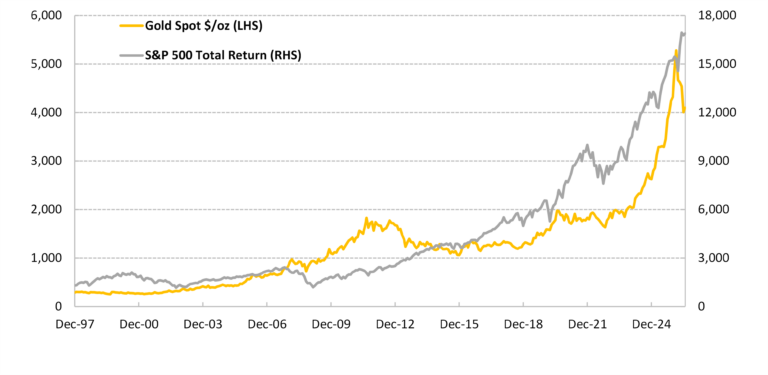
Source: Bloomberg, TwinFocus
Reasons for holding gold
Gold is different from other commodities. Though an input for industrial and decorative uses, this demand is limited and as such gold is largely viewed and held as a monetary asset. Gold is indestructible with consistent production and prices that largely reflect changes in demand.
While it is possible to take tactical positions based on expectations around sentiment and monetary policy, the role of gold in a diversified portfolio is typically viewed as:
- Inflation and/or currency depreciation hedge. These risks are linked as currency depreciation typically translates into higher inflation. Gold tracks inflation over the longer-term, particularly during episodes of sharply rising inflation or very high inflation, though the relationship is imperfect and shorter-term correlation is low.
- Event risk hedge. Gold is viewed as a flight-to-safety asset, along with the US dollar, US Treasuries and the Japanese Yen, as historically large equity market drawdowns have coincided with positive cumulative returns for gold through the trough.
Factors that correlate with gold
As a result, there are several factors that correlate to gold prices and are viewed as drivers of price.
Real interest rates. Gold is a non-yielding asset and holding it carries an opportunity cost relative to interest-bearing assets. Historically, this cost was evident in the high negative correlation between gold and real interest rates (ρ ≈ -0.91) from 2003–2021. Recently, this relationship has weakened, turning moderately positive from 2022–2024 (ρ ≈ +0.45) while reverting to modestly negative from 2025–2026 (ρ ≈ -0.32).
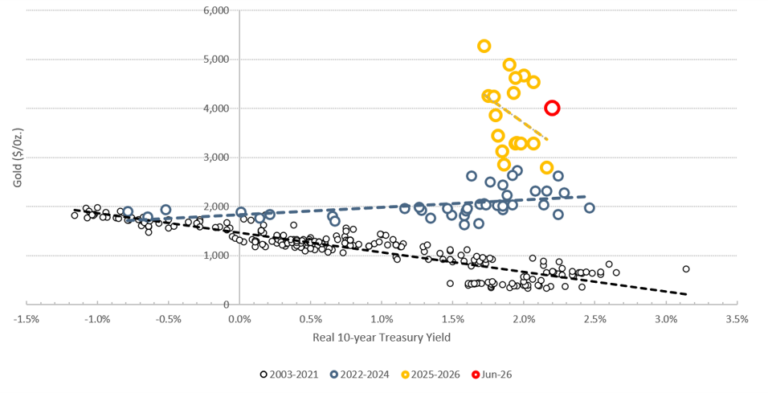
Source: Bloomberg, TwinFocus
US Dollar. Gold is generally priced in US dollars, with a stronger dollar making gold more expensive for non-dollar buyers, implying an inverse relationship. In practice, this link is not especially strong with two factors pulling in opposite directions: historically both have been viewed as flight-to-safety assets, rising together during periods of heightened uncertainty and market dislocations, while dollar demand rises with yields while gold demand has generally fallen.
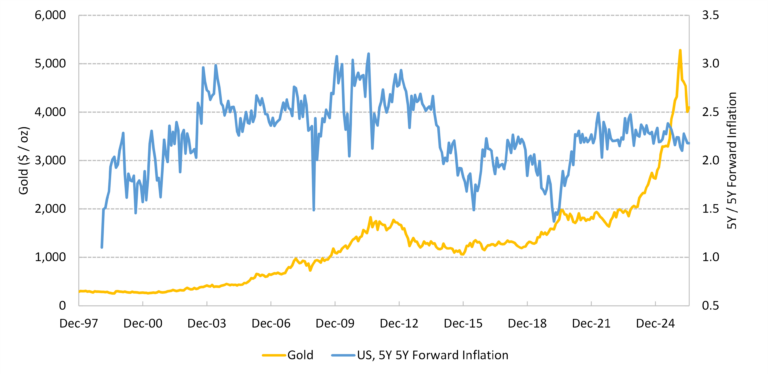
Inflation expectations. Despite prominence in media narratives, inflation expectations do not exhibit a reliable relationship with gold. As was the case in September 2025, inflation expectations have been stable and while gold may be discounting a different path or outcome than by the TIPS curve, it does not appear gold has dropped due to declining inflation expectations.
Geopolitical uncertainty. Gold typically benefits from demand for safe-haven assets during periods of heightened geopolitical uncertainty. While gold has historically been positively related to measure of uncertainty, the correlation is moderate and negative more recently. In 2025, gold moved higher as policy uncertainty fell post “Liberation Day” while gold peaked in January before falling in Q1 2026 as uncertainty rose with the start of the war in Iran. Gold may be related to policy uncertainty, but it is still unclear if the price reflects a significant “fear premium”.
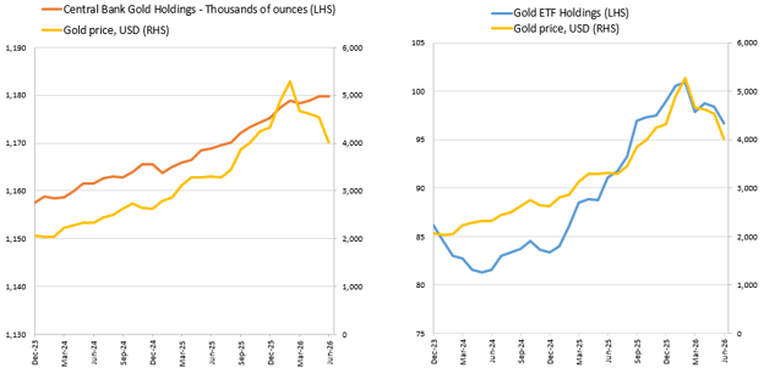
What happened in Q1 2026?
The changing signs and interrelationship of these factors suggest they reflect correlation not causality.
It is not coincidental that the term “gold bug” emerged in the 1930s, a period marked by declining trust in traditional financial assets and monetary frameworks. In more recent decades, debasement concerns have become more prominent with persistently large fiscal deficits and a rising debt burden. As such, we suspect the performance of gold reflects policy changes that have affected the perception of the US dollar as store of value and changing its status from an asset held by necessity to an asset held by choice.
Conclusion
Overall, we view gold as a store of value and do not believe its role in a diversified portfolio has fundamentally changed.
Gold remains a strategic, long-term allocation within many TwinFocus portfolio solutions. We view gold primarily as a portfolio diversifier and risk-management tool that complements traditional financial assets by helping preserve purchasing power over long investment horizons and enhancing portfolio resilience during periods of market stress, elevated inflation, geopolitical uncertainty, or shifts in monetary policy.
While gold has, at times over the past few years, traded more closely in line with other risk assets, its strategic value is best evaluated across full market cycles rather than over isolated periods of performance. The past three years have been an exceptional period for gold, with prices benefiting from a unique combination of persistent inflation concerns, robust central bank purchases, heightened geopolitical uncertainty, and evolving expectations surrounding global monetary policy. More recently, during the second quarter, renewed upward pressure on interest rates, uncertainty surrounding the Federal Reserve’s leadership transition, and changing expectations for inflation and future policy have contributed to broader market volatility and reinforced the importance of maintaining diversified portfolio
As with any asset class, gold will inevitably experience bouts of underperformance, but those short-term fluctuations should not detract from its enduring role as a source of diversification within a well-constructed portfolio. Our conviction remains unchanged: current allocations reflect a disciplined, long-term portfolio construction process rather than a directional market call. We are not attempting to speculate on near-term price movements or time the market. Instead, we continue to believe that maintaining an appropriate strategic allocation to gold can strengthen diversification and improve portfolio resilience over the long term.
MEMORANDUM DISCLOSURES
This Memorandum is confidential and may contain legally privileged and proprietary information of Twin Focus Capital Partners LLC (“TwinFocus”). It is intended solely for the use of the Recipients to which it is addressed. If you are not the intended recipient, you are hereby notified that any dissemination, copy, disclosure, use or action taken based on this Memorandum or any information herein is strictly prohibited and may be unlawful. If you received this Memorandum in error, please contact the sender immediately and destroy the material in its entirety, whether electronic or hard copy.
This Memorandum may not be otherwise redistributed, retransmitted or disclosed, in whole or in part, or in any form or manner, without the express written consent of Twin Focus Capital Partners LLC.
Investments involve numerous risks, including, among others, market risk, counterparty default risk and liquidity risk. In some cases, securities, strategies and other financial instruments may be difficult to value or sell and reliable information about the value or risks related to the security, strategy or financial instrument may be difficult to obtain. Income from such securities, strategies and other financial instruments, if any, may fluctuate and that price or value of such securities, strategies and instruments may rise or fall and, in some cases, investors may lose their entire principal investment. Foreign currency rates of exchange may adversely affect the value, price or income of any security or financial instrument mentioned in this Memorandum. Investors in such securities and instruments effectively assume currency risk. Additionally, before investing in any mutual fund strategies, Recipients are advised to obtain and closely review prospectuses and related information for those strategies before making any final investment decision.
Hedge fund and other alternative investments are generally unregulated and considered inherently very risky and you can lose material portions of your principal in very short periods of time. Prior to making any investments in any hedge fund managers and alternative investment strategies, you should thoroughly review all subscription documents and confidential offering memoranda provided by the managers/strategies, paying particular attention to the risk disclosures. You should not invest in such managers/strategies if you are not thoroughly comfortable with these risk disclosures or do not understand and/or appreciate the increased levels of risks associated with such strategies. Additionally, this Memorandum may provide information regarding private funds/strategies/investments which are exempt from registration under the Investment Company Act of 1940 pursuant to Section 3(c)(1) and/or 3(c)(7) which were offered as private placements in reliance on Regulation D of the Securities Act of 1933. Each individual fund/strategy and NOT TwinFocus shall have the sole responsibility for (i) formally qualifying prospective investors to ensure they meet the suitability criteria to invest in each relevant fund/strategy and, once qualified, (ii) sending the formal offering documents and other materials to each prospective investor.
Any information relating to the tax status of financial instruments and/or strategies discussed herein is not intended to provide tax advice or to be used by anyone to provide tax advice. Recipients are urged to seek tax advice based on their particular circumstances from an independent tax professional. Any waiver by TwinFocus of any section of this Memorandum Disclaimer Statement should not be construed as a general waiver of any other section and/or the entire Memorandum Disclaimer Statement.
The information, including but not limited to forecasts and estimates, in this Memorandum was obtained from various sources and TwinFocus does not guarantee its accuracy. Although the information contained in this Memorandum are from sources believed to be reliable, no representation or warranty, expressed or otherwise, is made to, and no reliance should be placed on its fairness, accuracy, completeness or timeliness.
All opinions, projections and estimates are as of the date of the Memorandum and are subject to change without notice. TwinFocus is under no obligation to update this Memorandum and Recipients should therefore assume that TwinFocus will not update any fact, circumstance or opinion contained in this Memorandum unless specifically requested. TwinFocus and any director, officer or employee of TwinFocus do not accept any liability whatsoever for any direct, indirect or consequential damages or losses arising from any use of this Memorandum or its contents.
This Memorandum may contain current opinions of third-party authors and not necessarily those of TwinFocus. Such opinions are subject to change without notice.
This Memorandum may contain references to market indices. Such information is presented to show the general trends in certain markets for the periods indicated and is not intended to imply that the strategy(s) discussed and/or reviewed are similar to the indices either in composition or element of risk. TwinFocus does not make any representations as to whether the indices may or may not be unmanaged, not investable, have any expenses and may or may not reflect reinvestment of dividends and distributions. Index data is provided for comparative purposes only. A variety of factors may cause an index to be an inaccurate benchmark for a particular portfolio/manager/strategy and the index does not necessarily reflect the actual investment strategy of the portfolio/manager/strategy discussed and/or presented in the Memorandum. Current period returns may be estimates. Actual index returns and/or estimates are calculated and presented to TwinFocus through third party software providers and as such, may differ from the final figures produced by the index provider.