
In November 2025, we outlined the case for an investment in Japanese equities, arguing that Japan had evolved from a value trap to a more compelling long-term equity opportunity supported by improvements in company fundamentals, policy initiatives, and structural corporate governance reforms.
Despite progress, return on equity and asset turnover remained well below developed market peers, suggesting the reform cycle was still in its early stages and fundamentals had room to improve further. In addition, though Japanese equities had outperformed the S&P 500 through Q3 2025, they lagged Europe and EM markets. Still, valuations remained attractive relative to global equity markets.
We concluded that for long-term investors there was a case for a dedicated Japanese equity allocation as part of a fully invested, globally diversified portfolio. This note revisits that conclusion.
The fundamental reform and valuation story remains in place.
Company fundamentals continue to have room for further improvement.
While the return on common equity for Japanese equities has nearly tripled since 2000, fleetingly rising above Europe, it remains just above 10%. Nearly on par with Chinese equities, it remains below global markets; roughly 20% below Europe, ~30% below EM and 50% below US levels.
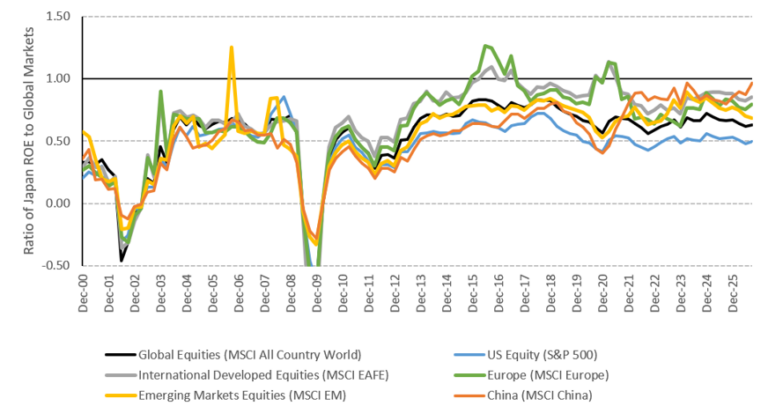
Source: Bloomberg, TwinFocus
Corporate and market reform momentum, targeting capital efficiency and shareholder returns, remains.
- The revised Corporate Governance Code was finalized in July 2026. Boards are now expected to continuously check whether cash and other financial and physical assets are being used effectively.
- As it continues efforts to make the TOPIX a more investible representation of Japanese equity markets, the Japan Exchange Group (JPX) announced in October 2026 that it was reducing the number of constituents by ~40% with the weights of removed stocks reduced quarterly through July 2028. Index inclusion will be based primarily on liquidity and free-float market capitalization. The goal is to encourage companies to reduce non-core holdings (e.g., cross-shareholdings and real estate) and cash to repurchase shares or issue dividends.
- Returns to shareholders have increased accordingly. In June 2026, Goldman Sachs reported that TOPIX companies returned ¥43T (~$277B assuming 155 ¥/$), reflecting higher dividend payouts and share buybacks, in fiscal 2025 (ending March 2026). Noting that buyback authorizations for fiscal 2026 have risen over 20% compared to 2025, though the number of programs fell slightly. This reflects increasing concentration in larger programs.
Progress is reflected in market returns and foreign capital flows.
- Through early October 2026, Japanese equities have outperformed broad DM markets while lagging EM markets which have benefitted from strong AI and semiconductor flows, e.g., South Korean equities are up over +60% following a +95% return in 2025. Large-cap Japanese equities have similarly benefitted, with the Nikkei 225 outperforming the broader MSCI and TOPIX indices YTD.
- Nikkei Asia, compiling Tokyo Stock Exchange data, reports overseas investors made net purchases of ¥9.7T (~$60B) in the first half of 2026, the largest half-year total on record and outpacing purchases following the Abenomics stimulus package in 2013.
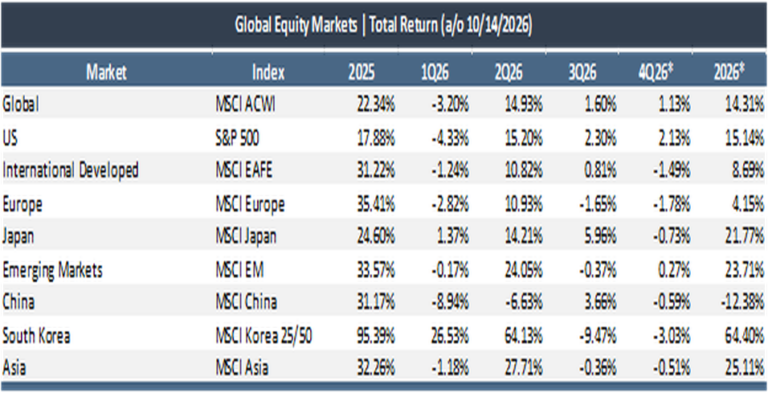
* As of 10/14/2026
Source: Bloomberg, TwinFocus
Valuations are higher but remain relatively attractive.
- Investors have rewarded the fundamental and regulatory improvements with higher valuations, with the forward P/E ratio for the MSCI Japan index now being above the 20-year average. Japanese equities remain relatively attractive compared to US markets while in line with Europe and Asian markets.
- Japanese price-to-book ratio (P/B) remains below broad developed and emerging markets.
- In addition, Japanese mid-cap and small-cap stocks appear priced at more attractive levels with the Nikkei trading at a 22x forward P/E and 3x P/B, compared to ~17x and ~1.8x for the broader TOPIX.

Source: Bloomberg, TwinFocus
Higher interest rates and a weak Yen as potential headwinds.
- The Bank of Japan (BoJ) has increased rates in response to rising inflation and wage momentum, raising concerns of triggering another deleveraging. The unwind in 2024 was triggered by a surprise BoJ rate increase which coincided with weaker US data and thin markets, resulting in forced sales across currencies and equities. The current BoJ policy path has been well signaled and tightening is expected.
- Higher rates raise funding costs for the Japanese government with gross government debt exceeding 230% of GDP. However, the government held consolidated financial assets of ~171% of GDP in 2025, more than half of which were equities and foreign securities, lowering net consolidated liabilities to ~65% of GDP.
- A weak yen makes imports more expensive, notably energy, exacerbating a fiscal position and weight on US dollar returns. However, currency valuation models suggest the yen is undervalued while the joint US / Japan intervention in July suggests a potential floor, if not a stronger yen.
Conclusion
Corporate governance and regulatory reform momentum continue to support Japanese equity values. While valuations have risen, they remain attractive relative to global markets. For long-term investors, the case for dedicated active Japanese equity allocation as part of a fully invested, globally diversified portfolio remains.
Disclosure Statement
This material has been prepared by TwinFocus for informational and educational purposes only and is not intended as, and should not be construed as, personalized investment advice or a recommendation to buy, sell, or hold any security, investment strategy, or asset class. The views and opinions expressed are based on information available as of the date of publication and are subject to change without notice.
Certain information contained herein has been obtained from third-party sources believed to be reliable, including Bloomberg and other sources identified herein; however, its accuracy or completeness cannot be guaranteed. Any forecasts, estimates, expectations, or other forward-looking statements are based on current assumptions and are inherently uncertain. Actual results may differ materially.
Past performance is not indicative of future results. Index performance is provided for illustrative and comparative purposes only. Indices are unmanaged, do not reflect fees, expenses or transaction costs, and are not directly investable. Differences in index composition, methodology, currency, and other factors may limit comparability.
Investments in foreign securities involve risks in addition to those associated with domestic investments, including currency fluctuations, political and economic developments, differences in regulation and accounting standards, and potentially greater market volatility and liquidity risk. Diversification does not ensure a profit or protect against loss. Investment decisions should be made based on an investor’s individual objectives, risk tolerance, liquidity needs, time horizon, tax circumstances, and other relevant considerations.